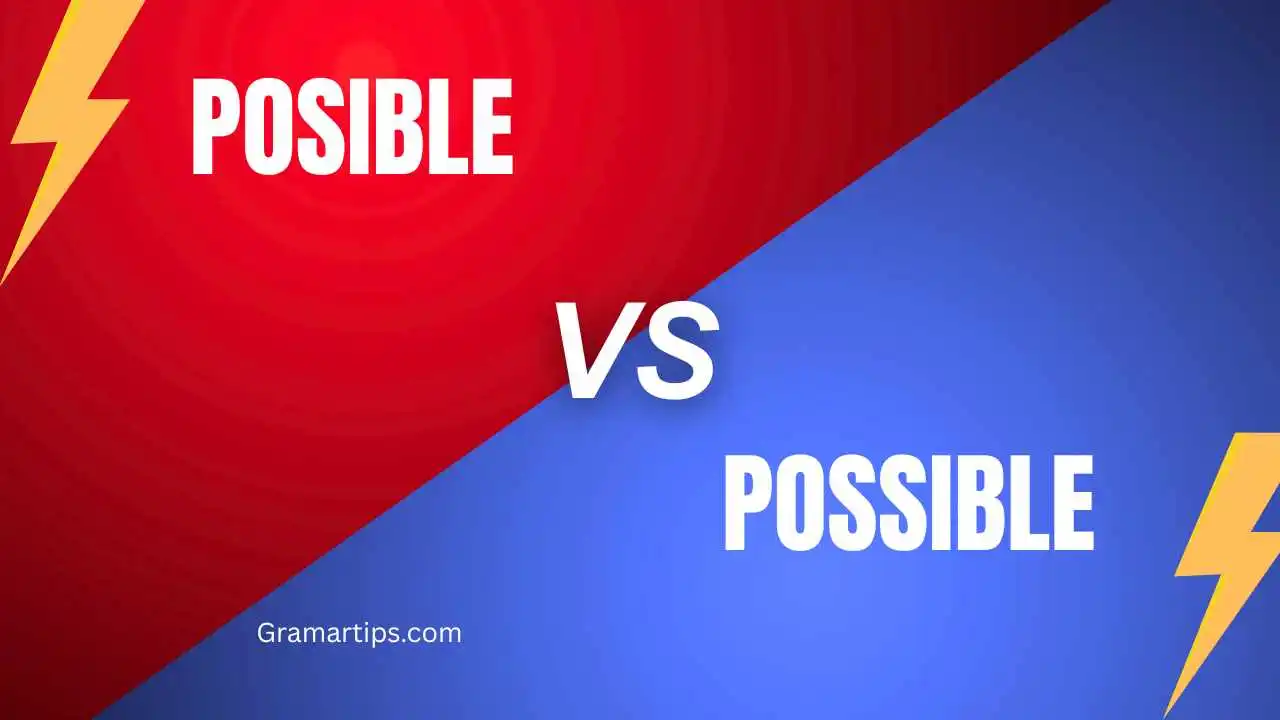
Confused about Posible vs Possible and not sure which one is correct? You’re not alone this is one of those small spelling mistakes that can easily slip into everyday writing. I’ve been there too, typing quickly and only later realizing something didn’t look right.
At first glance, both words may seem similar, but only one is actually correct in English. Understanding the difference can instantly improve your writing and make it look more professional.
You’re writing messages, emails, or content, correct spelling really matters. Even a tiny error can change how your message is perceived. That’s why it’s important to clear this confusion once and for all.
✅ Quick Answer / Summary
- “Possible” is the correct English spelling meaning something that can happen or be done.
- “Posible” is incorrect in English and is considered a spelling mistake (it belongs to Spanish).
📖 What Does “Possible” Mean?
The word “possible” means:
✨ Examples of “Possible” in Sentences
- It is possible to learn English with daily practice.
- Is it possible to finish the work today?
- Everything is possible if you believe in yourself 💪
- This solution is the best possible option.
- Is there a possible explanation for this problem?
👉 Synonyms (related words):
- Feasible
- Achievable
- Doable
- Likely (in some contexts)
❌ What About “Posible”?
The spelling “posible” is not correct in English. However, it is:
- ✔️ Correct in Spanish
- ❌ Incorrect in English writing
🚫 Incorrect Usage Examples
- ❌ It is posible to solve this problem.
- ❌ Is it posible to attend the meeting?
👉 These should always be written as:
- ✅ It is possible to solve this problem.
- ✅ Is it possible to attend the meeting?
⚖️ “Possible” vs “Posible” – Comparison Table
| Feature | Possible ✅ | Posible ❌ |
| Correct in English | ✔️ Yes | ❌ No |
| Meaning | Can happen or be done | Same meaning (Spanish) |
| Language | English | Spanish |
| Usage | Writing, speaking, academic, formal | Spanish communication |
| Example | It is possible to win the game | Es posible ganar el juego |
Possible vs Probable Meaning
Here’s a clear comparison table to help you understand the difference between possible and probable:
| Feature | Possible | Probable |
|---|---|---|
| Meaning | Something that can happen or exist | Something that is likely to happen |
| Chance Level | Low to uncertain chance | High chance or strong possibility |
| Usage | Used for general potential | Used when something is more expected |
| Certainty | Not sure / uncertain | More confident / likely |
| Example | It is possible that it will rain today | It is probable that it will rain today |
This table makes it easy to see that possible means “it can happen,” while probable means “it will likely happen.”
🧠 Common Mistakes and Grammar Tips
Many learners make the mistake of writing “posible” instead of “possible.” Let’s understand why:
🔍 Why the confusion happens
- Spanish uses “posible”
- English adds an extra “s” → possible
- The pronunciation sounds almost the same
Possible Synonym
The word “possible” refers to something that can happen or be done under certain conditions. A possible synonym for it includes words like likely, feasible, achievable, or potential.
For example, a possible plan means a plan that can work or be completed. It is commonly used in everyday English to show probability or capability.
Possible in English
In English, “possible” is an adjective used to describe something that can happen or exist. It shows that there is a chance of something occurring, even if it is not guaranteed.
It helps express hope, uncertainty, or capability in communication.
Possible Meaning
The meaning of “possible” is something that can be done, achieved, or may happen. It indicates that there is no restriction or impossibility in a situation. If something is possible, it means it is within reach or doable.
💡 Easy Memory Trick (Mnemonic)
👉 Remember this simple trick:
“Possible has more ‘s’ because English needs extra support.”
Or:
“Only one S is Spanish, but double S makes it English possible!”
🌍 Real-Life Examples of “Possible”
✉️ Email Example
“We will try to complete the project as soon as possible.”
📱 Social Media Example
“Dream big, work hard, and make the impossible possible 💫”
📰 News Example
“Scientists are exploring all possible causes of the phenomenon.”
🎓 Academic Example
“It is possible that the results may vary depending on conditions.”
💬 Everyday Speech
- “Is it possible to meet later?”
- “Yes, everything is possible with effort!”
🌎 British vs American English Usage
Good news! 🎉
👉 There is no difference between British and American English when it comes to:
- spelling of possible
- meaning
- usage
✔️ Both use “possible”
❌ Both avoid “posible”
🚨 Common Mistakes to Avoid
Here are some typical errors learners make:
❌ Wrong:
- It is posible to finish today
- This is the most posible outcome
✅ Correct:
- It is possible to finish today
- This is the most possible outcome
🧩 Grammar Tip: Position of “Possible”
The word possible is an adjective, so it is used to describe nouns.
✔️ Correct Usage
- A possible solution
- A possible answer
- The possible outcome
✔️ With “as…as possible”
- Please come as soon as possible
- Do it as carefully as possible
- Speak as clearly as possible
📌 Advanced Usage of “Possible”
1. Modal Context (Polite Expressions)
- “Could you possibly help me?”
- “Is it possible that he is late?”
2. With “If Possible”
- “Come early, if possible.”
- “Contact me if possible.”
3. Superlative Usage
- “This is the best possible solution.”
- “We want the highest possible quality.”
❓ FAQs About “Possible vs Posible”
1. Is “posible” correct in English?
❌ No, “posible” is incorrect in English. The correct spelling is “possible.”
2. Why do people write “posible”?
Because in Spanish, the correct word is “posible”, which causes confusion for English learners.
3. How do you spell “possible” correctly?
It is spelled:
👉 P-O-S-S-I-B-L-E
4. What is the meaning of “possible”?
It means something that can happen or be done.
5. Can I use “possible” in formal writing?
- Academic writing
- Business emails
- Professional communication
6. Is “possible” used differently in British and American English?
❌ No, both use the same spelling and meaning.
7. What is the opposite of “possible”?
👉 The opposite is “impossible.”
🎯 Conclusion
The difference between “possible” and “posible” is simple but important:
- ✅ “Possible” = correct English spelling
- ❌ “Posible” = incorrect in English (Spanish word)
By remembering this small spelling rule and practicing regularly, you can avoid one of the most common English mistakes. 💡
👉 Always double-check your spelling, especially in professional or academic writing. With time, using “possible” correctly will become second nature!
Read More Articles
Thier or Their – Meaning, Usage, and Examples Explained for 2026
Per Se or Per Say: Common Confusion, Rules, and Examples for 2026
Optimize or Optimise Meaning, Examples, and Correct Usage Explained for 2026
Suing or Sueing – Meaning, Rules, and Examples for 2026