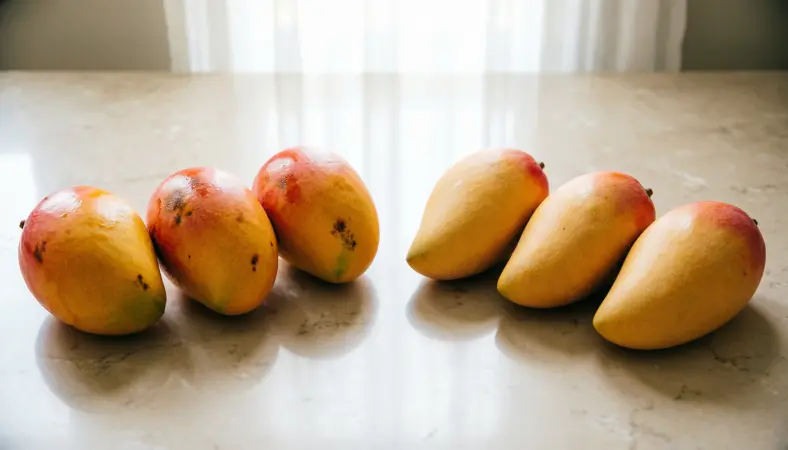
Have you ever wondered why some people write mangoes while others write mangos? It might seem confusing at first, but the difference is mostly about spelling preferences and regional usage. Both words refer to the same delicious, juicy fruit that’s loved around the world.
Mangoes is the more common spelling in British English, while mangos is often used in American English. Beyond spelling, there’s no difference in taste, nutrition, or the fruit itself. Yet, knowing which form to use can make your writing look polished and professional.
In this guide, we’ll explore the subtle distinctions, history, and correct usage of Mangoes vs Mangos. By the end, you’ll never be unsure which spelling to pick again.
Quick Answer: ✅
Both mangoes and mangos are correct plural forms of mango. However, mangoes is more commonly used in formal and standard English.
Now, let’s break it down in a simple, friendly way so you’ll never get confused again!
Understanding the Word “Mango” 🥭
A mango is a sweet, tropical fruit loved around the world. It comes from the mango tree and is especially popular in countries like India, Pakistan, Mexico, and the Philippines.
- Singular: mango
- Plural: mangoes or mangos
The confusion comes from English plural rules. Some words ending in -o add -es, while others just add -s. That’s where things get tricky!
Why Is There Confusion Between Mangoes vs Mangos? 🤯
In English grammar, nouns ending in -o sometimes form plurals by adding:
- -es (like tomatoes, potatoes)
- -s (like pianos, photos)
So what about mango?
👉 Historically, mangoes became the standard plural because many fruit names ending in -o take -es.
👉 Over time, mangos also became accepted, especially in American English.
Both spellings are considered correct in modern dictionaries.
What Does “Mangoes” Mean? 🥭
Mangoes is the traditional and more widely accepted plural form of mango.
✅ Usage of Mangoes
- Used in formal writing
- Common in academic texts
- Frequently found in British English
- Preferred in dictionaries and style guides
📌 Examples of Mangoes in Sentences
- I bought three mangoes from the market.
- The basket was filled with ripe mangoes.
- Pakistan exports high-quality mangoes worldwide.
- She made a smoothie using fresh mangoes.
- The farmer harvested hundreds of mangoes this season.
In most grammar books and English usage guides, mangoes is listed first as the primary plural form.
Mango Meaning Slang
In modern slang, the word “mango” can have different meanings depending on the context, social media platform, and region. It is not always related to the sweet tropical fruit. Sometimes, people use mango as a playful nickname, a compliment, or a coded word in online conversations.
For example, someone might call another person a “mango” to describe them as sweet, attractive, or lovable. In some internet communities, the meaning can vary based on trends and cultural references. Therefore, it is important to understand the context in which the slang term is used.
Examples:
- “You are such a mango!” (Meaning: You are sweet or adorable.)
- “That person is my little mango.” (Meaning: A cute nickname)
- “The meaning of mango in this meme depends on the joke or trend.”
Mangos or Mangoes: Which Plural Form Is Correct?
Many English learners get confused between mangos and mangoes when writing the plural form of mango. The good news is that both spellings are correct, but their usage can depend on regional preferences and style guides.
- Mangoes is the more traditional and widely used plural form.
- Mangos is also accepted and is commonly seen, especially in American English.
Examples of Mangoes
- I bought fresh mangoes from the market.
- The trees were full of ripe mangoes.
- She made a delicious smoothie using mangoes.
Examples of Mangos
- The store sells imported mangos from different countries.
- We ordered several boxes of mangos.
- The recipe requires two ripe mangos.
Difference Between Mangos and Mangoes
| Feature | Mangoes | Mangos |
|---|---|---|
| Correct spelling | ✅ Yes | ✅ Yes |
| Common usage | More traditional and common | More common in American English |
| Formal writing | Often preferred | Also acceptable |
| Meaning | Plural of mango | Plural of mango |
Easy Memory Tip
If you are unsure which spelling to use, choose mangoes, as it is the more common and traditional form used in many dictionaries. However, mangos is not incorrect, especially in American English.
Both words mean the same thing, so the best choice is to remain consistent throughout your writing.
What Does “Mangos” Mean? 🥭
Mangos is also a correct plural spelling of mango. It’s simply a shorter variation.
✅ Usage of Mangos
- More common in American English
- Used in informal writing
- Seen in marketing and branding
- Popular in casual speech and social media
📌 Examples of Mangos in Sentences
- We planted five mangos in our backyard.
- The recipe calls for two ripe mangos.
- California farms grow delicious mangos.
- She sliced the mangos for fruit salad.
- The store had organic mangos on sale.
Even though mangos looks unusual to some people, it is grammatically correct.
Mangoes vs Mangos: Comparison Table 📊
| Feature | Mangoes | Mangos |
| Correct Spelling | ✅ Yes | ✅ Yes |
| Formal Writing | More common | Less common |
| Informal Usage | Common | Very common |
| British English | Preferred | Less common |
| American English | Common | Also common |
| Dictionary Acceptance | Standard | Accepted variant |
| Example Sentence | I love sweet mangoes. | I love sweet mangos. |
Why Do Some Words Add -es and Others Just -s? 📚
English has specific plural rules, but there are many exceptions.
General Rule for Words Ending in -O:
Most words ending in -o preceded by a consonant add -es.
Examples:
- Tomato → Tomatoes
- Potato → Potatoes
- Hero → Heroes
But some add just -s:
- Piano → Pianos
- Photo → Photos
- Radio → Radios
Mango falls into a special category where both forms are accepted.
Memory Trick to Remember Mangoes vs Mangos 🧠✨
Here’s a simple mnemonic:
👉 If you’re writing something formal, think of tomatoes and use mangoes.
👉 If you’re writing something casual, mangos is fine too!
Or remember this fun trick:
“Mangoes are fancy, mangos are casual.” 😄
That way, you’ll choose the right spelling depending on your audience.
Real Life Examples in Different Contexts 🌍
Let’s see how both words appear in real-world situations.
📧 Email Example (Formal)
Dear Sir,
We are pleased to inform you that the shipment of fresh mangoes has arrived.
📱 Social Media Post
Summer vibes with juicy mangos 🥭☀️ #FreshFruit
📰 News Headline
Farmers report record exports of Pakistani mangoes this year.
📚 Academic Writing
The nutritional value of mangoes includes high levels of Vitamin C and fiber.
🛒 Grocery Store Sign
Fresh Mangos – $2.99 per pound!
As you can see, mangoes appears more in formal and professional contexts, while mangos is common in marketing and casual settings.
British vs American English 🇬🇧🇺🇸
Regional differences also play a role in spelling preferences.
| Region | Preferred Form |
| British English | Mangoes |
| American English | Mangoes (standard), Mangos (accepted) |
| Australian English | Mangoes |
| Informal U.S. Usage | Mangos common |
In general, British English strongly prefers “mangoes.”
American English accepts both but still leans toward mangoes in formal writing.
Common Mistakes People Make ❌
Here are some frequent common mistakes related to mangoes vs mangos:
1. Thinking “Mangos” Is Wrong
It’s not wrong! It’s just less common in formal English.
2. Using Both in the Same Document
Avoid switching between mangoes and mangos in one piece of writing. Choose one and stay consistent.
3. Assuming All -O Words Follow the Same Rule
English has exceptions. Always check a dictionary for correct spelling.
When Should You Use Mangoes vs Mangos? 🤔
Use Mangoes When:
- Writing essays
- Academic writing
- News reports
- Professional emails
- International audience content
Use Mangos When:
- Writing casually
- Social media posts
- Marketing copy
- U.S.-focused content
- Informal blogs
Frequently Asked Questions (FAQs) 📝
1. Is mangoes or mangos correct?
Both are correct plural forms of mango. However, mangoes is more widely accepted in formal English.
2. Why do some people write mangos?
In American English, dropping the “-es” is common for some -o ending words. So mangos became an accepted alternative.
3. Which spelling is more common worldwide?
Globally, mangoes is more commonly used, especially in British English and formal writing.
4. Is mangos grammatically incorrect?
No, it is grammatically correct. It’s simply less traditional than mangoes.
5. Do dictionaries accept both mangoes and mangos?
Yes. Major dictionaries list both forms as correct plural spellings.
6. Should I use mangoes in academic writing?
Yes. Mangoes is preferred in academic and formal writing.
7. Are there other fruits with similar plural rules?
Yes! Words like:
- Tomato → Tomatoes
- Potato → Potatoes
- Avocado → Avocados
English plural rules can vary depending on the word.
Final Thoughts: Mangoes vs Mangos 🥭✨
So, what’s the final verdict?
Both mangoes and mangos are correct plural forms of mango. However:
- Mangoes is more traditional and preferred in formal, academic, and international English.
- Mangos is accepted, especially in American and informal contexts.
If you want to play it safe, choose mangoes. It works everywhere! 🌍
The key to good English usage is consistency. Pick one spelling based on your audience and stick with it.
Now you can confidently write about delicious mangoes (or mangos!) without second-guessing yourself. 🥭😄
Read More Articles
Kurt or Curt in English Meaning, Usage & Examples for 2026
Sence or Sense Common Spelling Mistake Explained for 2026
Abley or Ably Explained: Meaning, Grammar, and Examples for 2026