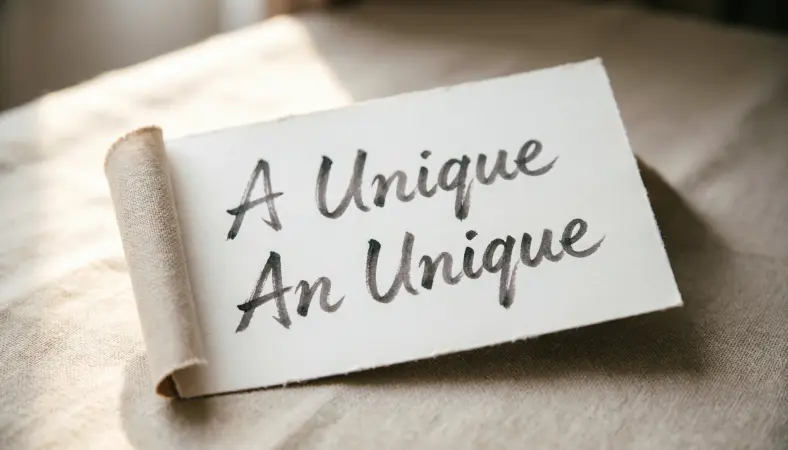
Have you ever paused and wondered whether it’s correct to say “A Unique” or “An Unique”? Many people get confused, and it’s actually a common grammar question that trips up even native speakers.
The confusion comes from the way the word unique sounds starting with a “yoo” sound making it feel like it should follow the rule for vowels. Grammar rules can be tricky, especially when pronunciation doesn’t exactly match spelling.
Understanding the right usage not only helps you write correctly but also makes your sentences sound polished and professional. By the end, you’ll never second-guess to use “a unique” or “an unique” again. Writing with confidence has never been easier!
Quick Answer: ✅
The correct phrase is “a unique”. We use “a” before words that start with a consonant sound, not just a consonant letter. Since “unique” starts with a “yoo” sound, it gets “a”, not “an.”
Let’s break it down in a fun and easy way!
What Does “Unique” Mean?
Before diving into the article, it’s important to understand the word itself.
Definition:
- Unique = one of a kind, special, or unlike anything else.
Examples:
- She has a unique style that no one can imitate.
- This museum has a unique collection of ancient artifacts.
- His perspective on life is truly unique.
Notice that unique is always singular when describing something special or one of a kind.
Why It’s “A Unique,” Not “An Unique”
English articles (a or an) depend on sound, not spelling.
- Use “a” before words that begin with a consonant sound
- Use “an” before words that begin with a vowel sound (a, e, i, o, u)
Even though unique starts with the vowel letter “u,” the sound is /juː/ (“yoo”), which is a consonant sound.
Examples:
- ✅ She is a unique person.
- ❌ She is an unique person. (Incorrect)
- ✅ He told a unique story.
- ❌ He told an unique story. (Incorrect)
Comparison Table: A Unique vs An Unique
| Phrase | Correct? | Usage Rule | Example Sentence |
| A Unique | ✅ Yes | Use “a” before consonant sounds (e.g., “yoo”) | She has a unique approach. |
| An Unique | ❌ No | Incorrect: “unique” starts with consonant sound | ❌ I found an unique idea. |
Tip: Always pronounce the word first. If it starts with a vowel sound, use an; if it starts with a consonant sound, use a.
Other Examples with Similar Words
Here are some tricky words that follow the same rule as unique:
| Word | Correct Article | Example Sentence |
| University | a | He attends a university in London. |
| Uniform | a | She wore a uniform at school. |
| European | a | He is a European citizen. |
| Hour | an | I waited for an hour. |
| Honest | an | She gave me an honest opinion. |
💡 Memory Tip: Think of the sound not the letter. “Yoo” = consonant → a, vowel sounds like “o” or “ah” → an.
Common Mistakes and How to Avoid Them
- Mistake: Using “an unique” because “unique” starts with “u.”
- ✅ Fix: Remember the “yoo” sound rule → a unique.
- ✅ Fix: Remember the “yoo” sound rule → a unique.
- Mistake: Confusing “u” words that sound like vowels.
- Words like umbrella, uncle, under → vowel sound → use an
- Words like university, unique, unicorn → consonant “yoo” sound → use a
- Words like umbrella, uncle, under → vowel sound → use an
- Mistake: Overgeneralizing “an” before all vowel letters.
- ✅ Fix: Focus on pronunciation, not spelling.
- ✅ Fix: Focus on pronunciation, not spelling.
Mnemonic:
- “Yoo” = consonant → a
- “Ah/uh” = vowel → an
Real Life Examples
Emails & Formal Writing:
- I’m excited to share a unique opportunity with you.
- Our team has developed a unique strategy for growth.
Social Media:
- She’s rocking a unique look today! 😍
- This is a unique moment I’ll never forget.
News & Academic Writing:
- The research presents a unique solution to climate change.
- The artist’s work is a unique reflection of modern society.
Notice how “a unique” sounds natural and professional everywhere.
British vs American English Usage
Interestingly, the rule for “a” vs “an” is the same in both British and American English.
| English Variant | Rule for Unique | Example Sentence |
| British English | a unique | She has a unique perspective. |
| American English | a unique | He is a unique talent. |
No regional difference here, which makes it easy to remember!
FAQs (People Also Ask Style)
1. Is it “a unique” or “an unique”?
- ✅ Correct: a unique. The “u” makes a “yoo” sound, which is a consonant sound.
2. Why do people get “a unique” wrong?
- Because “u” is a vowel letter, but English articles depend on sound, not letters.
3. Can “unique” ever use “an”?
- ❌ No. “Unique” always starts with the consonant “yoo” sound, so a unique is always correct.
4. What are other words similar to “unique”?
- Words like university, unicorn, European also take a, not an.
5. How do I remember when to use “a” or “an”?
- Pronounce the word first: if it starts with a vowel sound → an, consonant sound → a.
6. Does British English say “an unique”?
- No, both British and American English use a unique.
7. Can I say “a truly unique” instead?
- ✅ Yes! Example: a truly unique experience. The article remains a.
Conclusion: Key Takeaways
- Always say a unique, never an unique. ✅
- The rule depends on sound, not spelling. “Yoo” sound = consonant → a.
- Use this tip for all tricky “u” words: unicorn, university, European.
- Remember our mnemonic: “Yoo = a, Ah/uh = an”.
With this simple rule, your writing will sound polished, professional, and grammatically correct! 🌟